Comp AI Review: After the Series A, Hosted and Open Source Are Two Codebases (2026)
Published May 19, 2026 · Updated November 11, 2026 · by Jonathan Hildebrandt
The short version
Comp AI raised a $34M Series A in September 2026 and now claims 1,000+ customers, but its GitHub README says the hosted Comp AI Cloud is proprietary and built on a separate codebase. What that does to the open-source case against Vanta, Drata, and Secureframe, what the security-testing push actually ships, and who should still buy it. Rated 4.0.
Pros
- ✓Comp AI Community Edition is still AGPLv3 code on GitHub that you can self-host and read, including the integrations catalog and the device agent, per the repo README
- ✓1,000+ companies on the platform per the trycomp.ai homepage (fetched Nov 11, 2026), backed by a $34M Series A led by Roo Capital and Grand Ventures per SiliconAngle
- ✓The pricing page quotes 12 named frameworks, including SOC 2, ISO 27001, HIPAA, GDPR, PCI DSS, ISO 42001, and FedRAMP
- ✓AI penetration testing, a trust center, and the audit itself can be scoped into one quote, per the trycomp.ai pricing page
- ✓1:1 Slack support with a stated response time under 3 minutes, per the homepage
Cons
- ✕Pricing is still gated behind a 20-minute call; Secureframe now publishes a starting price on its own pricing page
- ✕1,000+ customers per the trycomp.ai homepage versus the 16,000 businesses Vanta claims on its own homepage (both fetched Nov 11, 2026)
- ✕Auditor familiarity with Comp AI's evidence format still trails Vanta and Drata, which have the longer history with SOC 2 audit firms
Comp AI Review: After the Series A, Hosted and Open Source Are Two Codebases (2026)
In May, Comp AI's pitch fit in one line: a SOC 2 platform whose evidence collectors you can read on GitHub. Since then the company has raised a $34 million Series A (SiliconAngle, September 17, 2026) and rewritten the top of its own README. The hosted Comp AI Cloud "is built and operated as its own product on a separate codebase," and the comparison table under that sentence lists its source as "Proprietary" (trycompai/comp README, changed October 22, 2026 in PR #3602). The open repo is now called Community Edition, and it is the free, self-hosted version.
Our pick, by buyer. A 5-to-50-person SaaS that needs SOC 2 quickly should still shortlist Comp AI Cloud next to Vanta and Drata. Buy it for the turnaround and the Slack support; the code you can audit belongs to a different product. A team that has to read what touches its infrastructure should run Community Edition itself. A company whose auditor and procurement contacts already know Vanta should stay put. The rating moves from 4.2 to 4.0, and the open-source split is the reason.
What changed between May 19 and November 11
| What | May 19, 2026 review | November 11, 2026 | Source |
|---|---|---|---|
| Funding to date | $2.6M pre-seed (August 2025) | $34M Series A on top, led by Roo Capital and Grand Ventures | SiliconAngle |
| Customers claimed | 700+ | 1,000+ | trycomp.ai, fetched Nov 11 |
| Hosted product vs. repo | README: "core technology (99%) is fully open source" | README: Cloud is "Proprietary," on a separate codebase | README |
| Frameworks named | Five on the homepage | 12 on the pricing page, FedRAMP included | Pricing page |
| Pricing | Sales call | 20-minute pricing call, "Money-back guarantee" listed | Pricing page |
| GitHub stars | 1.6k | 2.1k | trycompai/comp, Nov 11 |
Most of those rows are good news for a buyer. The third one is the problem, because it was the thesis of the original review.
The open-source claim, re-read
Go to trycomp.ai today and section 06 of the homepage still says: "We're fully open source. Every agent, every integration, every check is auditable on GitHub." Then open the repo README. Community Edition and Cloud "share a lot of DNA and ideas travel in both directions, but each is developed and released independently, with its own features, fixes, and timelines." Community Edition gets community support through Discord and GitHub issues. Cloud gets paid plans, managed hosting, and dedicated support.
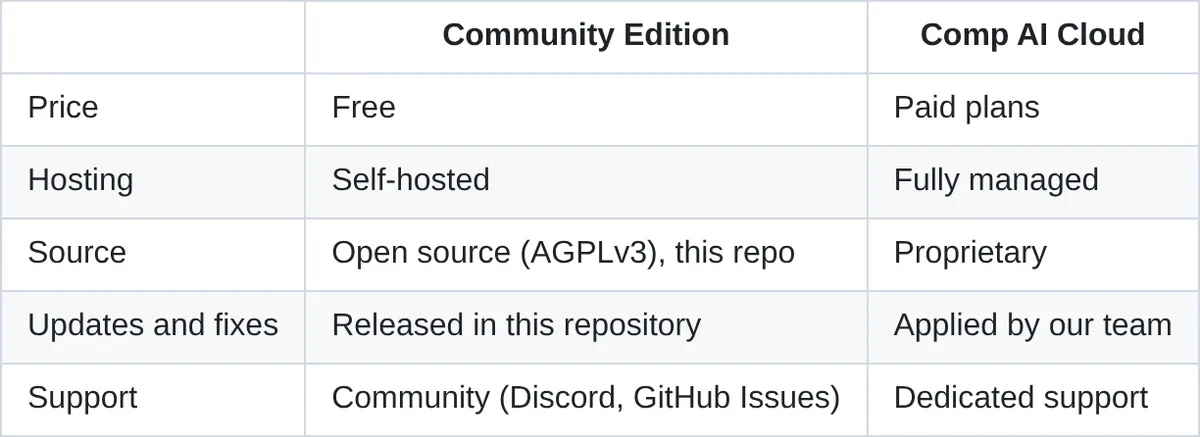 Source: github.com, captured November 11, 2026.
Both statements can't describe the hosted product at once. The README is the more specific document, and the more recent one.
In May we told readers that when a prospect's security engineer asks what the AWS collector reads, you can point them at the integrations-catalog folder. That still answers the question for Community Edition. For Cloud, it shows what a related codebase does, not necessarily what runs against your account. The homepage still links open packages for the device agent and the integration platform, and neither page says whether Cloud ships those packages unmodified.
So ask. On the pricing call, request a written list of which Cloud components match the public repo, and put it in the security addendum if open code is part of why you are buying. Vanta, Drata, and Secureframe publish no source code at all, so Comp AI still edges ahead of them on transparency. It is just no longer a clean yes.
Self-hosting Community Edition
The AGPLv3 path is real and documented. The repo carries a Dockerfile, a docker-compose.yml, and a SELF_HOSTING.md that points to a fuller Docker guide in the docs. The minimum deployment needs an external PostgreSQL 14+ database with SSL, a Resend account for email, and a Trigger.dev account for background workflows. Setting NEXT_PUBLIC_SELF_HOSTED=true skips the payment and booking flow. The apps/ folder now includes the main app, the trust portal, the API, a browser extension, a framework editor, and an MCP server (apps folder).
The funding changes the self-host risk in a specific way. A company that has raised $36.6 million in total, per SiliconAngle, is unlikely to disappear and orphan your deployment next year. (TechCrunch puts the total at $37.5 million in its coverage; the two outlets disagree.) What replaces that risk is drift: Community Edition ships on its own timeline, so a feature you see in a Cloud demo may never reach the repo.
AGPLv3 still carries copyleft for network-deployed software. If you fork Community Edition to run a derivative service for other companies, you owe them source. Get counsel before you build a business on a fork.
What the Series A money pays for
Two things, and only one of them exists today.
Shipped: AI penetration testing. The homepage lists it as a feature ("Agents probe your code, APIs, and infrastructure"), CEO Lewis Carhart described it to TechCrunch as the platform that "proactively tests codebases and infrastructures for vulnerabilities," and the pricing page treats penetration testing as one of the things that changes your quote. In May we called pen testing "bundled into the platform tier." The current pricing page reads as a priced add-on to the scope, so treat it that way.
Roadmap: continuous security testing. Per SiliconAngle, the company wants its agents running security tests against customer applications and infrastructure, which it describes as moving "beyond audit readiness and into cybersecurity." SecurityWeek reports the plan as real-time monitoring and control validation across applications and infrastructure, plus hiring in Miami and New York. Nothing on the site sells it yet; it is stated intent.
The growth numbers come from the company. Annual recurring revenue multiplied 15 times over the past year "according to the company," per SiliconAngle, and fintech.global adds a self-reported 10x rise in customers. Neither figure is audited, and the company gave no starting ARR, so the multiples tell you direction and say nothing about size.
For a buyer who already pays a pentest firm, the move is simple. Keep that vendor this cycle. Ask Comp AI for a sample pen-test report on the pricing call, and switch only after your auditor and your largest customer have both accepted one.
What the platform does well
Framework coverage widened. The pricing page quotes SOC 2, ISO 27001, HIPAA, GDPR, PCI DSS, SOC 1, NIST, ISO 42001, ISO 9001, CCPA, NEN 7510, and FedRAMP. The homepage headline dropped FedRAMP and now names four frameworks, which looked like a removal at first. It isn't one: FedRAMP is still in the homepage's "Pick your frameworks" step, in the enterprise tier copy, and on the pricing page's quote list, all on November 11.
Evidence collection runs through 580+ integrations per trycomp.ai, against "400+ tools" on vanta.com. An open-source device agent checks disk encryption, firewall, screen lock, password length, and antivirus on employee machines. You can also write automated tests in plain English; the homepage example is "show me that SSL is active on my domain," which becomes a daily check.
Support is the feature customers quote back. The homepage promises 1:1 Slack with in-house experts who "respond in under 3 minutes" (trycomp.ai). Vanta's pricing page instead lists "access to expert partners" on its Essentials tier.
The case studies page gives vendor-reported audit-ready times: Persona AI and ShiftControl in 6 days, Capgo in 7, RiskInMind in 20, Luthor AI in 2 weeks for SOC 2 Type II, and Anodes AI in 5 weeks for HIPAA plus SOC 2. One correction: our May version listed Anodes AI at 8 days, and the case study now says 5 weeks. Strix is no longer on the page.
Pricing, checked November 11
| Vendor | Published price | Plans | Source |
|---|---|---|---|
| Comp AI Cloud | None; quoted on a 20-minute call | Scoped by frameworks, headcount, timeline, audit and pen-test needs | trycomp.ai/pricing |
| Comp AI Community Edition | Free (AGPLv3) | Self-hosted, community support | README |
| Vanta | None; "personalized pricing" after a demo | Essentials, Plus, Professional, Enterprise | vanta.com/pricing |
| Drata | None; Contact Sales | Foundation, Advanced, Enterprise | drata.com/pricing |
| Secureframe | Fundamentals from $7,500/year | Fundamentals, Complete, Defense | secureframe.com/pricing |
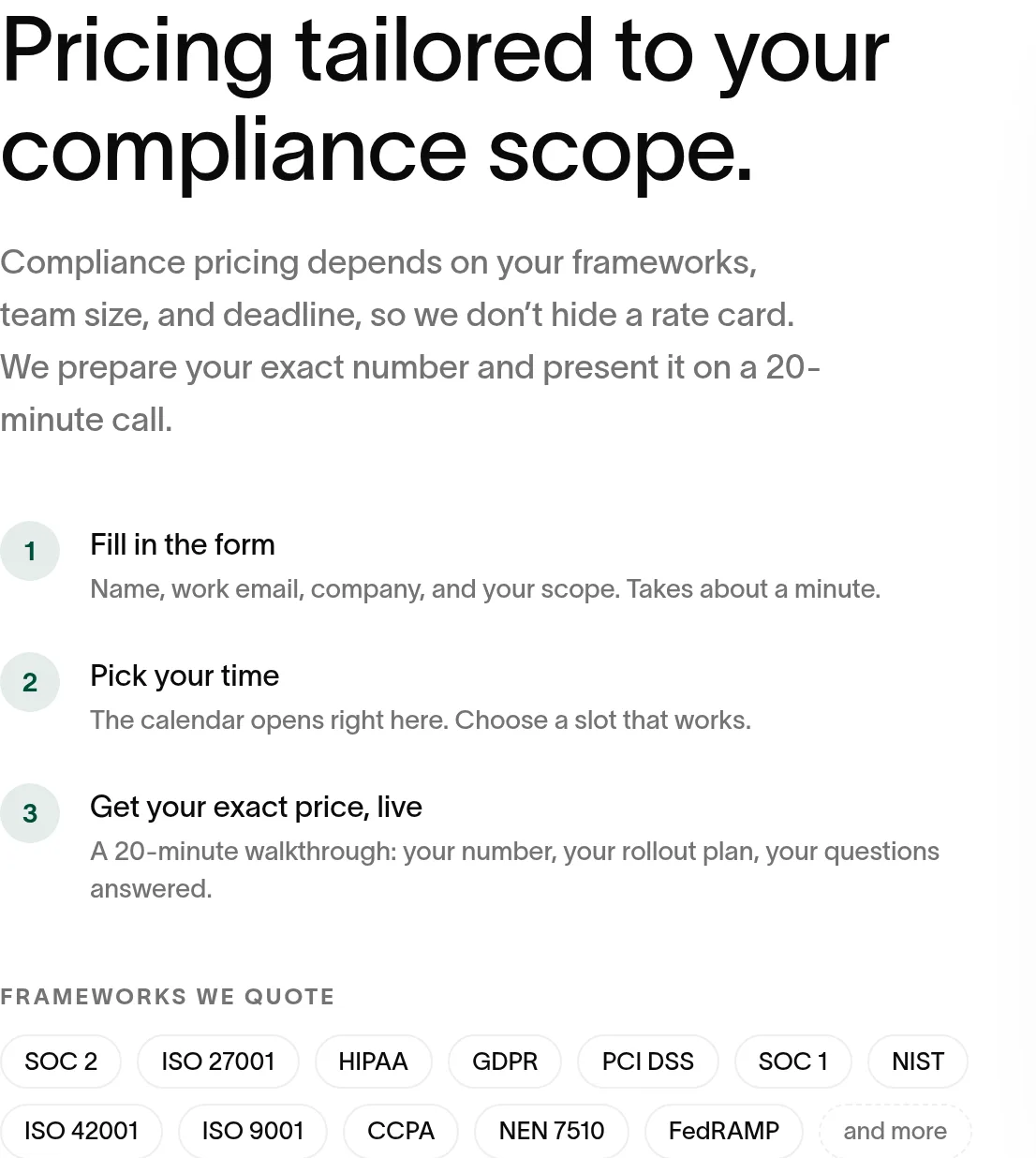 Source: trycomp.ai, captured November 11, 2026.
Secureframe is the change here. In May none of the four published a number; now Secureframe gives a starting price, so it is the anchor you bring to every other call. Comp AI's pricing page says the quote turns on four inputs (frameworks in scope, company size, timeline, and any audit, pen-testing, or trust-center scope) and that adding ISO 27001 to an existing SOC 2 program "starts about two-thirds done."
Self-host math, from our own cost model: a senior infrastructure engineer spending two days a quarter keeping Community Edition patched comes to roughly $8,000 a year in loaded cost, plus around $2,000 a year for managed Postgres, Trigger.dev, and email. Call it $10,000 a year before any vendor invoice. Below 30 employees, hosted usually wins on time. Above 50 with a platform team, self-hosting starts to pay, as long as you can live without features that only ship to Cloud.
Candid cons
Pricing is gated, and since Secureframe publishes a starting price on its pricing page, Comp AI is now behind at least one rival on that.
The maturity gap shrank but did not close: 1,000+ companies per trycomp.ai against "16,000 businesses" per vanta.com, both fetched November 11. If your audit firm has run dozens of Vanta engagements and no Comp AI ones, expect more questions about the evidence format.
The pick
Buy Comp AI Cloud if you are a 5-to-50-person SaaS chasing SOC 2 or ISO 27001 for mid-market deals and want a vendor in your Slack during the sprint. You are buying a proprietary hosted service from a company that also publishes a related open-source codebase. Get the open-source answer in writing before you sign. Start with Comp AI's hosted platform.
Run Community Edition if your buyer or your own security team requires reading the code that touches production, and you have someone to operate Postgres, Trigger.dev, and the upgrade cadence.
Pick Vanta if your auditor and largest customers already expect it. Pick Drata if you want the deepest automation from an incumbent and do not need open code. Pick Secureframe if you want to start from a published price.
Why 4.0 and not 4.2: nothing else in this update changes what you get on day one; the README split does.
Review history
This review is updated in place as the product changes. Earlier versions:
- November 11, 2026: After the Series A, Hosted and Open Source Are Two Codebases (current version). Covers the September 17 Series A, the 1,000+ customer count, the October 22 README split between Community Edition and Comp AI Cloud, the wider framework list, and Secureframe's published starting price. Rating lowered from 4.2 to 4.0. Corrects the Anodes AI audit-ready time (5 weeks, not 8 days) and drops the bundled-pen-testing claim.
- May 19, 2026: The Open Source Compliance Platform Taking on Vanta, Drata, and Secureframe (May 2026). Original review, rated 4.2.
Ready to try it?
Try comp-ai →