OpenAI ships MedChemBench, a chemistry benchmark that caps its best model at 84.5%
OpenAI's newest model can rebuild a chemical structure almost perfectly, but when the task shifts to picking which drug candidate to test next, the job a working medicinal chemist actually does, its score drops by roughly half, according to a benchmark OpenAI published on November 20, 2026.
What
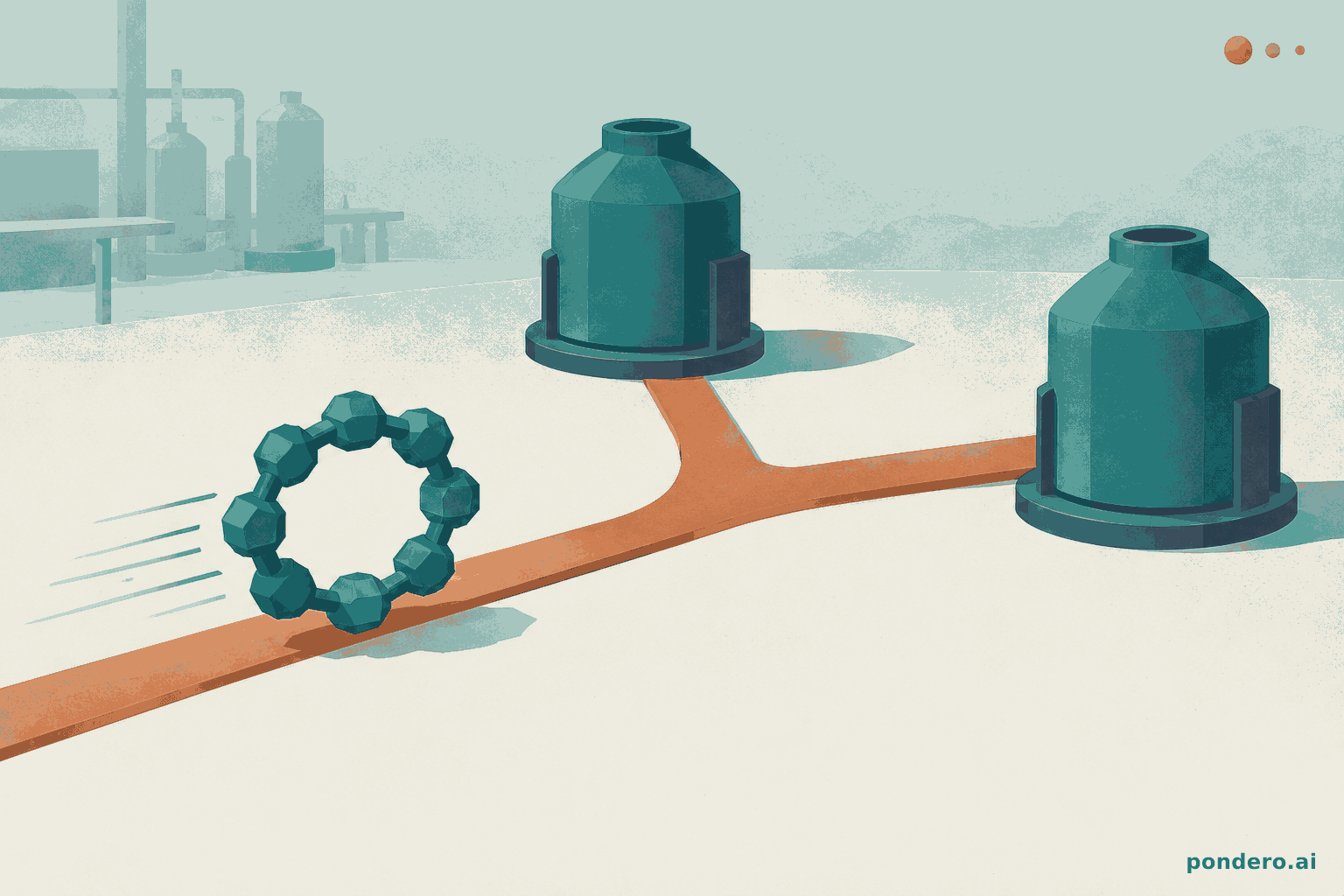
OpenAI introduced MedChemBench, a 99-problem benchmark built from 117 published papers and patents covering 761 distinct molecular structures, per OpenAI's research post. Each problem grades four separate skills: reconstructing a molecule's structure from drawings and chemical groups, explaining experimental results with the evidence supplied, ranking and selecting compounds against stated requirements, and predicting numerical or categorical properties. OpenAI tested eleven of its own GPT models at different reasoning-effort settings; at the benchmark's highest "xhigh" setting, GPT-6.2 Astra scored 84.5% of available credit, ahead of GPT-6 Astra's 83.3%, GPT-6.1 Sol's 82.0%, and GPT-5.6 Sol's 58.2%, per the same post. The gap between skills is wide: GPT-6 Astra earned 95.4% of available credit on reconstructing molecular structures at xhigh, but captured only about half the credit on selecting compounds and predicting their properties, the categories closest to the decisions a chemist makes in a lab. One spatial-reasoning test asked models to assemble a molecule while preserving an 18-atom ring; GPT-6 Astra reconstructed it correctly across all ten attempted responses, while GPT-5.6 Sol and GPT-5.6 Luna failed all ten, producing a 15-atom ring or two disconnected fragments.
MedChemBench grades reading chemistry, not running a lab
OpenAI's own writeup is explicit that the benchmark does not establish whether its models can discover new drugs or improve real laboratory decisions. Every response in the test came from a single attempt, with no tools and no feedback loop from an actual wet-lab result, and OpenAI says it cannot rule out that its models encountered some of the published source material during training. For a pharma or biotech team evaluating whether to route compound-design work through an AI model, the practical read is narrower than the headline score suggests: strong at parsing a molecule's structure and summarizing literature, per the 95.4% figure, but still well short of validated for the iterative pick-the-next-compound reasoning that defines medicinal chemistry work. The benchmark measures comprehension of chemistry that already happened, not judgment about chemistry that hasn't been tried yet.
What to watch next
OpenAI said it will share updates as its models advance against MedChemBench, so the number to track is whether a future release narrows the gap on compound selection and property prediction specifically, rather than gaining ground only through added reasoning effort on tasks the models already handle well. No competing lab has published its own MedChemBench score, or results against the preprint OpenAI linked alongside the benchmark, as of this writing.
Sources
- Can AI help scientists identify promising drug candidates?: OpenAI research post, November 20, 2026